RETAIL DISCOVERY

background
AT&T's retail store is its largest revenue channel — and yet the organization lacked a clear, design-informed picture of what actually happens there. While "digital first" was the stated strategic priority, the retail floor remained the place where most customers made their most significant decisions.
The friction was real, but it wasn't fully understood.
"We put a lot on the retail representatives to remember."
That observation from a stakeholder early in the project captured the core tension: a complex product ecosystem, multiple overlapping systems, and a rep standing in the middle of it all — expected to make it feel effortless for the customer.
the problem
AT&T lacked a retail-focused understanding of customer friction points, rep workflows, and the end-to-end omnichannel Shop & Purchase journey. Specific promotions — Tiered offers, Trade-in, Next Up, and No Promo — each introduced their own complexity, and no shared picture existed of how customers and reps experienced them together.
Without that clarity, design couldn't identify where to intervene or what to prioritize.
MY ROLE
I led design on a 12-week discovery engagement, working alongside an associate director and two designers. My focus was shaping the research participation, synthesizing findings into design artifacts, and framing the work for leadership in a way that could drive future investment.
RESEARCH
Our researcher developed the overall plan. I contributed by writing interview questions for stakeholder and retail staff sessions, observing in-store conversations, and taking notes during field visits.

The research covered three streams:
Stakeholder interviews — 16 participants across the retail ecosystem, including retail representatives, assistant store managers, and internal team members. These conversations mapped roles, current initiatives, and where organizational knowledge was fragmented.
Retail store visits — DFW locations — observing and interviewing store reps in the environment where the experience actually lives. Watching a rep navigate between systems mid-conversation made visible what no internal report could fully capture.
Customer survey — 403 respondents — collecting customer perceptions following recent store visits, giving quantitative texture to what the qualitative sessions surfaced.
Design Artifacts
Research findings were translated into artifacts designed to serve as a foundation for future retail work — not conclusions, but a shared starting point.
Face-to-face engagement model — a framework mapping how a rep moves from opening conversation to understanding customer needs, and how that conversation determines where in the interface the experience begins. It made explicit that the rep's flow is driven by dialogue, not a fixed sequence.
Interface building blocks — a structural model distinguishing between linear tasks (which depend on preceding steps) and non-linear tasks (which can surface at any point to respond to the conversation as it develops). This distinction was central to understanding why current interfaces create friction: they impose linearity on a non-linear experience.
Both artifacts were presented to leadership as reference tools for teams working on future retail initiatives.
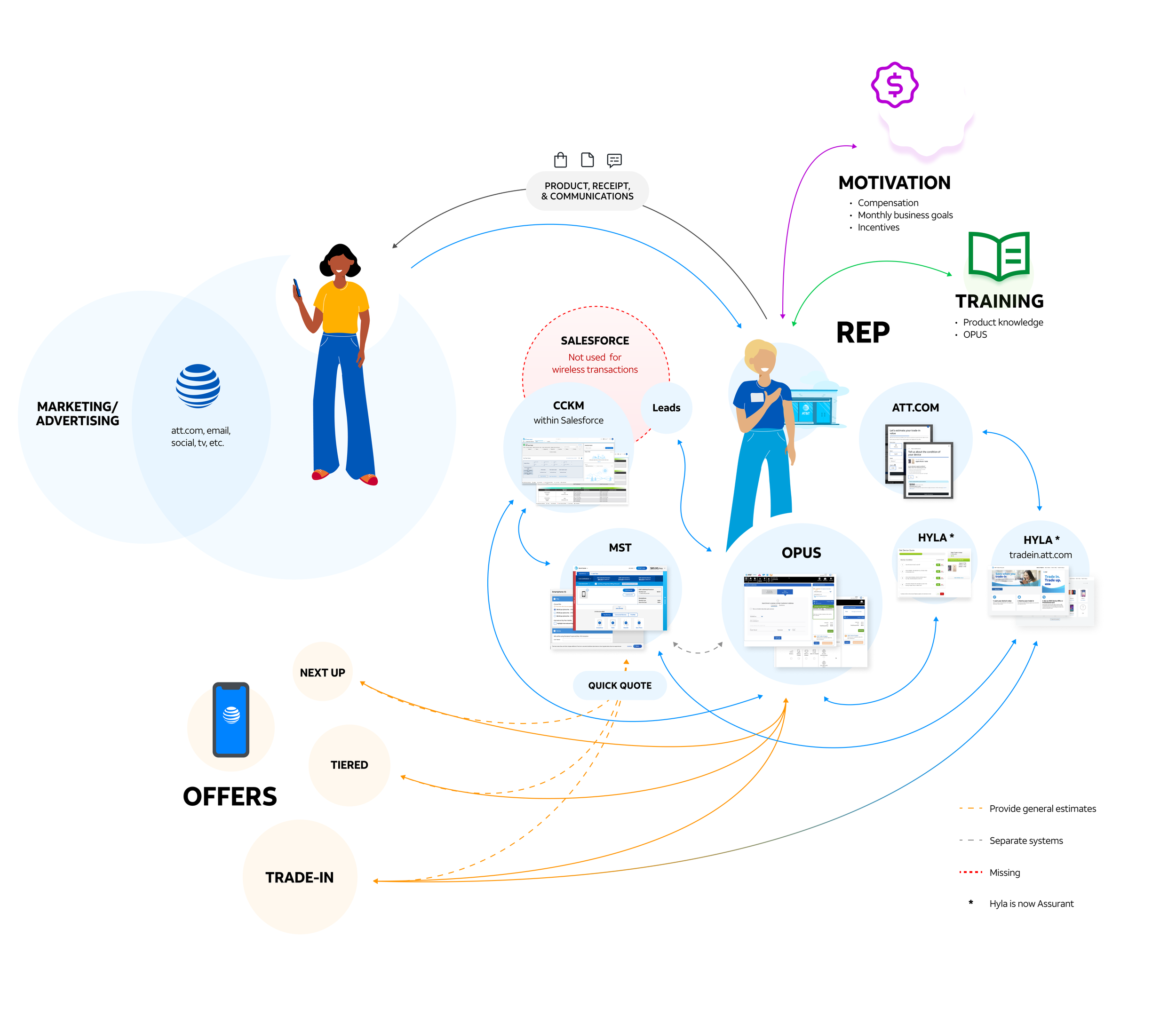
Ecosystem of the store representative tools
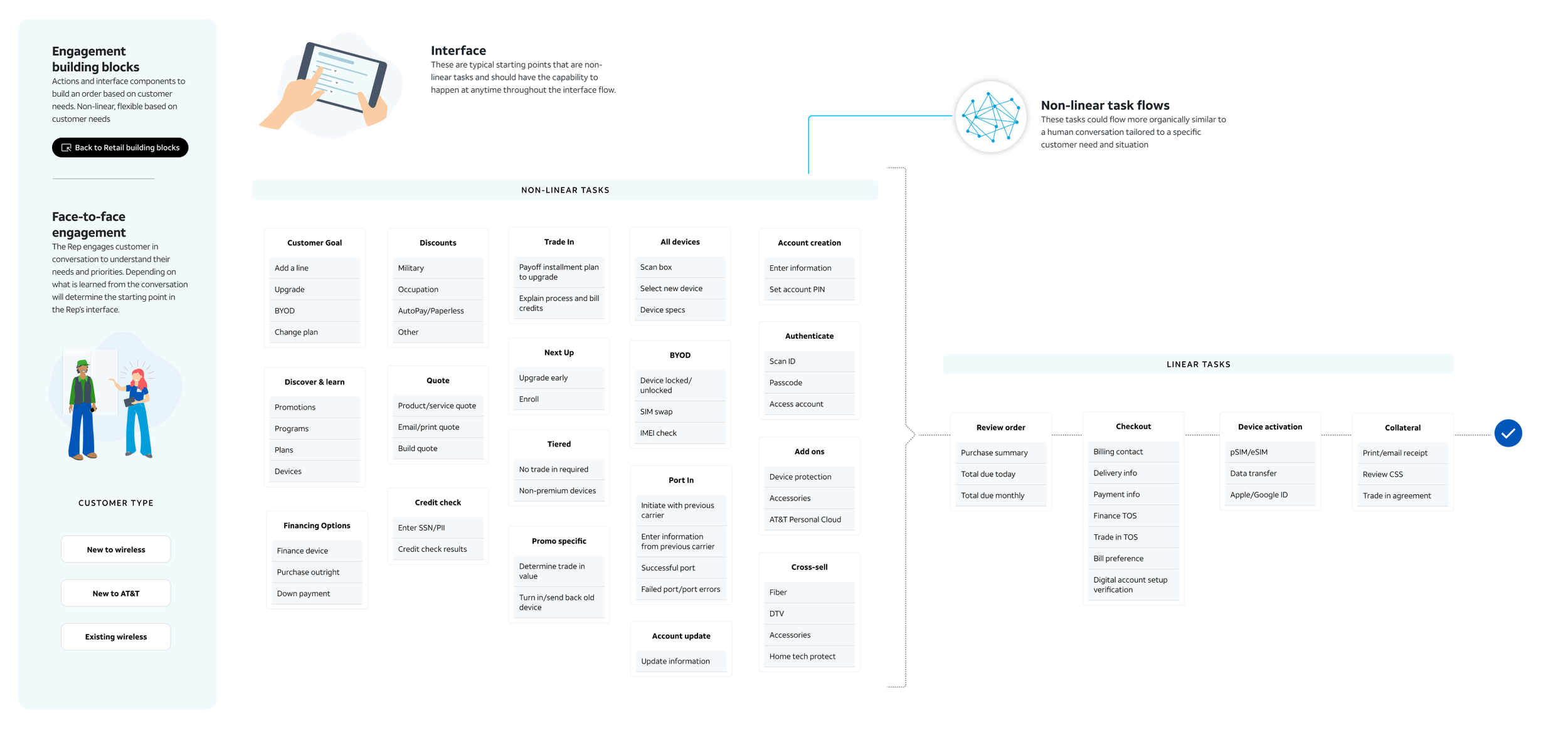
Face-to-face engagement
The Rep engages customer in conversation to understand customer needs and priorities. Depending on what is learned from the conversation will determine the starting point in the Rep’s interface.
Interface
The interface building blocks are made up of linear and non-linear tasks. The non-linear tasks should have the capability to happen at anytime throughout the interface flow to accommodate the rep/customer conversation while the linear tasks are dependent on preceding tasks

RECOMMENDATIONS & OUTCOME
The discovery work surfaced four areas where the organization needed to act:
Connect existing resources. Before building further, teams need a shared view of existing sitemaps, research, roadmaps, and communication touchpoints — including clarity on what continues to be built in the existing retail platform versus what moves to Salesforce.
Invest in more research. Tree testing with customers and reps can clarify future flow expectations. Qualitative rep interviews can identify the specific moments where the interface needs to pivot to match real conversation.
Explore a conceptual non-linear sales flow. A prototype built with rep guidance — not imposed on them — could test whether a more conversational interface structure reduces friction and surfaces the right information at the right moment.
Develop an enterprise retail experience strategy. A guiding playbook to align teams across AT&T — grounded in experience principles, customer narratives, and a clear picture of the target experience — would give future projects a shared direction rather than requiring each team to start from scratch.
Opportunities
These represent the highest-leverage places to improve the wireless retail Shop & Purchase experience:
Make the trade-in process legible from start to finish — customers and reps both need a clearer picture of how it works and what to expect.
Enable bi-directional communication across rep tools — so information flows between systems rather than requiring reps to carry it manually.
Remove unexpected barriers — last-minute credit checks, slow in-store Wi-Fi, and other friction points that surface late in a transaction and undermine confidence at the worst possible moment.
Standardize language across AT&T — so a customer hears the same story about saving money whether they're in a store, on the phone, or online.